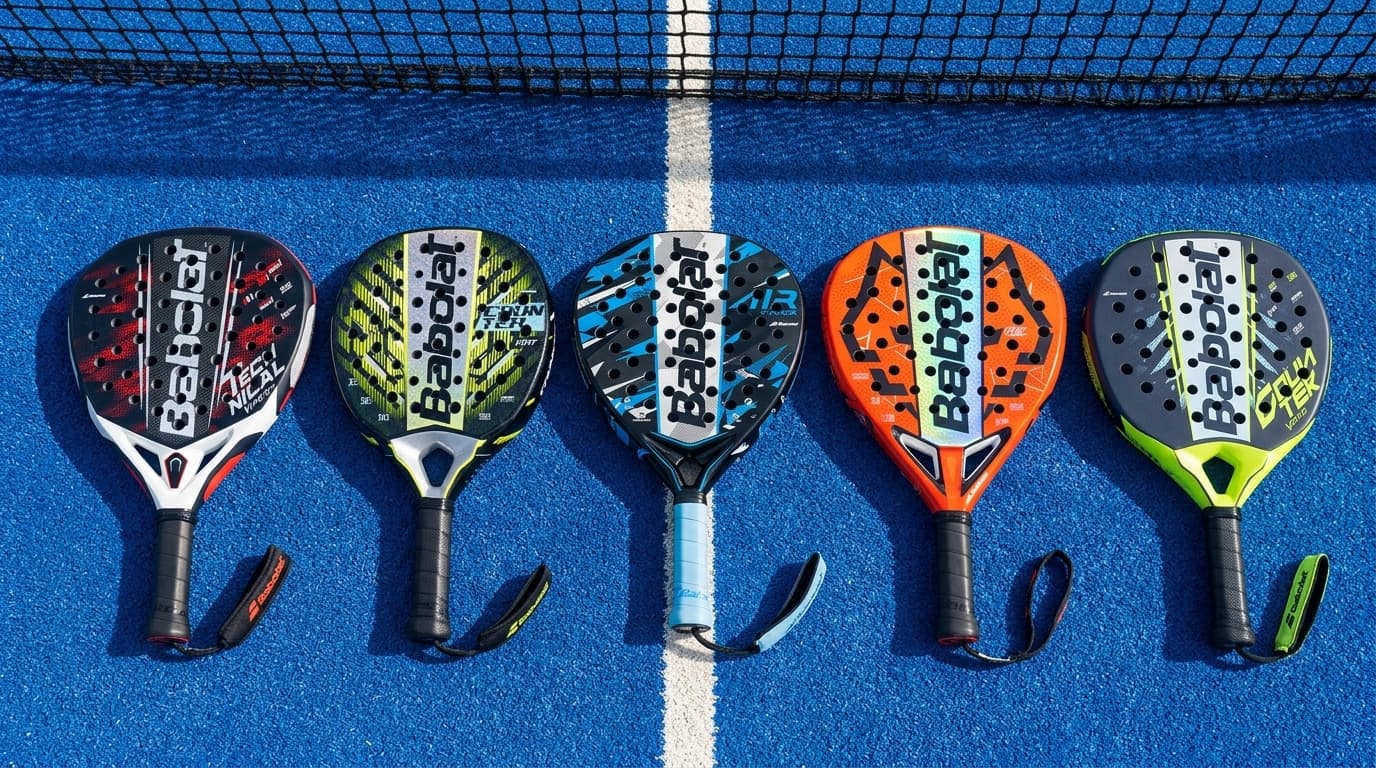
How the 2026 Babolat Range Is Structured
The best Babolat padel rackets in 2026 are built around a single philosophy: attacking padel. The brand that put Juan Lebrón at world number one doesn’t do passive. Every family in the 2026 UK lineup — Viper, Technical Viper, Air Viper, Veron — leans toward power and net play to some degree. Even the Counter Veron, Babolat’s most defensive model, is built for players who want to work their way forward and eventually finish. Understanding which family and which tier within it fits your game is what separates a racket that unlocks your play from one you’ll grow out of quickly.
The 2026 range runs on three construction tiers across the Viper line: the flagship Viper sits at the top; Technical Viper sits just below it with an almost-as-aggressive setup; Air Viper drops weight and softens the core for faster handling. Veron is the all-court and intermediate alternative — same attacking family DNA, accessed at different price points and construction levels. Counter Veron stands apart as the control option for players who prefer the back court.
Viper 3.0 — Lebrón’s Flagship
The Viper 3.0 2026 is where the Babolat line starts if attacking padel is your identity. Teardrop shape, 370g, high balance, 3K carbon face, EVA core. The 3K carbon is the stiffest face construction Babolat make — minimum deformation at impact, maximum pace off the face on a well-timed strike. The high balance loads overhead leverage without the full diamond commitment, so you keep enough back-court viability for transitional play. The 3D Spin texturing adds genuine effect on bandejas and smashes — it doesn’t just hit flat, it pins opponents into the glass.
This is a specialist tool. It rewards players who know where they’re going to be on the court, and punishes those who don’t.
Technical Viper 3.0 — The Attacking Pair
The Technical Viper 3.0 shifts to a diamond shape and switches the core to Black EVA — denser, harder, more aggressive in energy return. At 370g with a high balance, it’s Babolat’s most committed overhead weapon. The 3D Spin+ surface and Vibrabsorb System 2 take some of the edge off the physical demands — the elastomeric damper makes a real difference over a long session with a racket this stiff. Players who finish points with smashes as their primary weapon, rather than as one tool among several, belong here.
If the Technical Viper 3.0 sounds right but the stiffness feels like too much of a commitment, the Technical Viper Soft 3.0 makes the same aggression more sustainable. Soft Carbon faces and the same Black EVA core cut vibration without killing energy return — the overhead feels powerful but not brutal. Advanced players who’ve tried harder-faced diamonds and come back with arm issues often land here. Same diamond intent, better longevity.
Air Viper 2.6 — Attack With Less Weight
The Air Viper 2.6 is the most interesting model in the Viper family for a specific type of player: advanced attackers who rely on racket speed as much as racket weight. At 355g with a diamond shape and high balance, it trades 15g off the Technical Viper in exchange for a noticeably faster swing. The Carbon 16K face — more filaments than 3K, more flex — softens the feel slightly while still delivering explosive contact. The three-layer X-EVA core and Vibrabsorb System 2 keep the arm comfortable in a way that heavier diamond rackets rarely manage. If you play quick net exchanges, react late, and want to accelerate through the ball rather than drive through it, the Air Viper is the more natural fit than the heavier Technical versions.
Viper Soft 3.0 — The Bridge for Developing Attackers
The Viper Soft 3.0 is Babolat’s answer to a real gap in most attack-focused ranges: a diamond racket that intermediate players can actually use. Soft Carbon face, Black EVA core, 365g, high balance — the power and shape intent of the Viper family, with enough tolerance on off-centre hits to survive the timing inconsistencies that intermediate play involves. The Dynamic Stability System reinforces the frame’s centre to keep off-centre strikes more predictable. Players who are developing an attacking game and want to live in the diamond/high-balance world before they’re fully ready for the Technical Viper are well served here.
Air Veron 2.6 — The All-Court Option
The Air Veron 2.6 is the only model in the 2026 Babolat lineup that doesn’t force you to pick a court position. Hybrid shape, 355g, medium balance, Carbon Flex face. The blend of carbon and fibreglass on the face keeps the feel lively without the stiffness penalty — it transitions between offensive and defensive play without fighting you in either direction. At medium balance it’s fast to prepare and easy to redirect. This is where to start if your game is genuinely mixed — equal parts defending from the back, working the transitions, and finishing at the net — and you don’t want to commit to a high-balance diamond yet.
Veron Juan Lebrón 3.0 — Intermediate Attacking Entry Point
The Veron Juan Lebrón 3.0 brings the Lebrón diamond DNA within reach of improving players. Diamond shape, 360g, high balance, Carbon Flex face — the same attacking intent as the Viper family, built around a more forgiving Carbon + Fiberglass construction. The Dynamic Stability System reduces torsional flex on mishits, which means aggressive swings that aren’t perfectly centred stay more directionally honest. Black EVA core keeps impact comfortable across long training sessions. For a club player who’s 1–2 years in, has decided they want to attack, and is ready to move past a round beginner racket, this is a well-structured step up.
Counter Veron 2.6 — For Players Who Build From the Back
The Counter Veron 2.6 is Babolat’s most control-oriented model and the only round-shaped racket worth serious attention in the 2026 range. Low balance, 365g, Carbon Flex face, Black EVA core. It’s built for intermediate players who win points through consistency, placement, and making opponents miss — the opposite end of the style spectrum from the Viper line. The 3D Spin surface still gives you tactical variety on slice and angled shots, but the shape and balance tell the story: this racket is for people who live in the back court and want a tool that makes it easy to stay there under pressure.
Which Babolat Racket Should You Buy?
Babolat’s 2026 range rewards honest self-assessment. Start with one question: do you attack first or defend first?
Attack-first players belong in the Viper family — Technical Viper 3.0 if you’re advanced and want maximum overhead power, Air Viper 2.6 if you need racket speed alongside that power, Technical Viper Soft if arm comfort is a genuine concern. The Viper Soft 3.0 is the right entry point for intermediate attackers not yet ready for full carbon.
All-court players — those who transition between both court positions fluidly — have one clear answer: the Air Veron 2.6. It’s the only model in the range built for that style without compromise.
Players who defend, build points, and look to counter rather than impose belong in the Counter Veron 2.6, or, if they’re still developing fundamentals, should consider the broader picture in the best intermediate padel rackets 2026 guide before committing to a brand.
For how Babolat’s attacking models sit against the rest of the market, the best advanced padel rackets 2026 guide covers the cross-brand comparison.